

In two of my recent blog articles, I used the phrase “search intent.” Today, I want to break down exactly what that means in plain English, and show you why understanding it can influence your website’s local search visibility in Google. So, especially if you are a local, Scottsdale, AZ area business, please read on.
What Exactly is Search Intent?
Simply put, search intent is the real reason someone types a phrase into Google. Think of Google as a digital matchmaker and its entire business relies on giving people exactly what they want, instantly. When someone types a phrase into that search box, Google doesn’t just look at the literal words; it tries to figure out the user’s ultimate goal.
For example, look at these two searches in Scottsdale:
- “How to design a website”
- “Best web design company in Scottsdale”
The words are similar, but the intent is completely different.
In the first query, the person wants a free tutorial or DIY guide. In the second query, the person is investigating their options to hire a local web design professional. If your business website treats these two people the same way, you may likely be losing customers.
As such, Google’s automated systems are specifically designed to reward websites that instantly give the user exactly what they are looking for. To win more local customers, you need to understand the four main buckets Google uses to group your future clients.
The 4 Types of Google Search Intent (And How to Win Them)
- The “Just Curious” Shopper (Informational Intent)
These are people looking for quick facts, instructions, or deep advice. Google handles these in two different ways depending on how hard the question is.
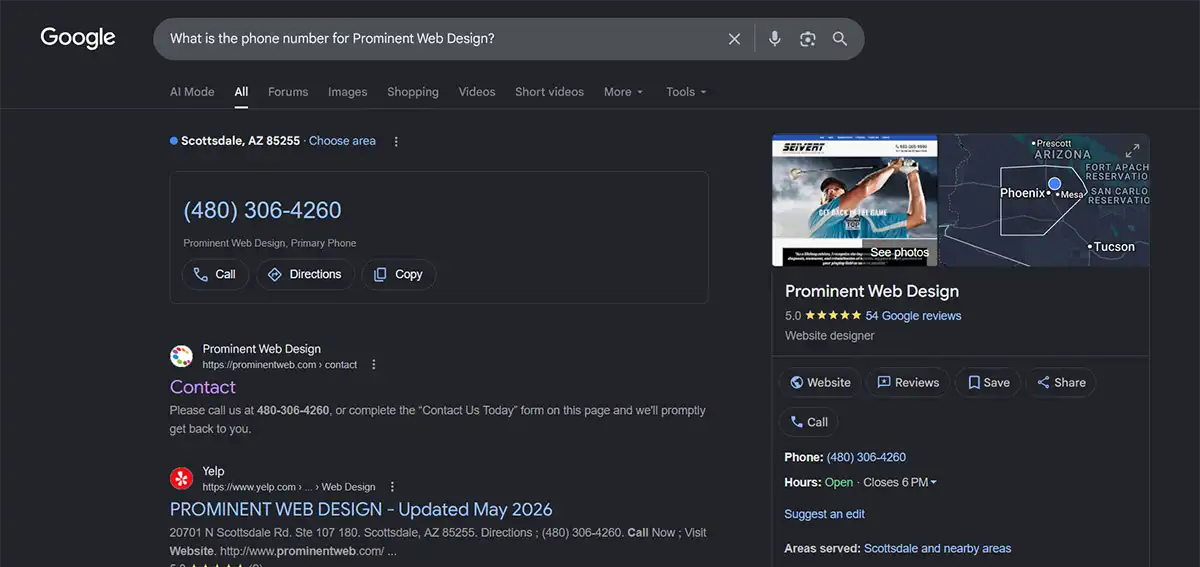
- The Quick Answer: This is when someone wants a fast, simple fact. For example: “What time does Scottsdale Fashion Square close?” or “What is the phone number for Prominent Web Design?” Google often displays these answers directly on the search results page using “Featured Snippets.” This creates a “zero-click search” where users get the answer without clicking your link. To win these, use short, direct sentences or bulleted lists on your contact and FAQ pages so Google can easily grab the data and display your business as the source.
- The Deep Question: This is when a user wants to explore a complex topic. For example: “Why is my AC blowing warm air?” or “How do I know if my AC refrigerant is leaking?” In these scenarios, these people aren’t ready to buy yet… instead, they are just troubleshooting. Let’s say you run a local HVAC company. Write a simple, friendly article on your website listing the top three reasons an AC blows warm air. By helping them for free, you become the trusted local expert they will call when they realize they need a professional repair.
- The “Direct Shortcut” Shopper (Navigational Intent)
This happens when someone already knows who you are and is simply using Google as a shortcut to get to a specific page on your website. Instead of typing your full web address, they type something like “Capital Grille menu” or “Papa Johns Pinnacle Peak phone number”.
You don’t need fancy blogging here. You just need a cleanly organized website. Make sure pages like your “Menu,” “Contact Us,” or “Book an Appointment” have clear titles so Google can display direct, clickable shortcuts straight to those pages right on the search results.
- The “Ready to Hire” Shopper (Commercial Investigation Intent)
This is the research and comparison phase right before someone buys. These users know what product or service they need, but they haven’t decided exactly who to buy it from yet. They use comparison words and type phrases like “Best web design company in Scottsdale” or “Top-rated plumber near me”.
When people are in this mindset, they want proof of quality, reputation and credibility. Your website pages targeting these keywords need to prove you are the safest bet. Feature immediate social proof (like badges showing off your 5-star reviews, customer testimonials, or local awards) and make it incredibly easy for them to see why they should choose you over your local competitors.
- The “Walking Through the Door” Shopper (Transactional & Local Intent)
This is where local businesses make their money right now. This bucket covers users who are ready to complete an action immediately, buy a product, or physically visit a business. They type high-urgency phrases like “Emergency roof repair near me”, “Hire a local plumber for clogged drain”, or search for “Coffee shop” while standing in downtown Scottsdale.
- For the “Visit-in-Person” crowd: Google looks at their phone’s GPS and pulls up a map of the closest physical businesses. To win these customers, your absolute top priority must be your Google Business Profile (your official Google Maps listing). Keep it updated with fresh photos, respond to every review, and ensure your business name, phone number, and address are identical everywhere online.
- For the “Transactional” crowd on your website: Skip the long stories. They want immediate action. Give them a massive, hard-to-miss button that says “Call Now” or “Book Online” so they can hand you their business instantly.
The Reality of “Mixed Intent”
Let’s face it, human behavior can be messy. Sometimes a single search means two things at once. If someone types “Home Depot,” they might want to go to homedepot.com (a shortcut navigational search), or they might be in their car wanting driving directions to the nearest physical location (a local map search). Google is smart enough to show both options at the same time.
The Golden Rule for Local Business Owners
Before you spend another dollar on website content, marketing, or blogging, do this simple, free thing first:
Open a private browser window on your smartphone, type in the exact keyword you want your business to show up for, and look closely at what Google displays on the screen.
- If Google shows a Map, focus your energy on getting more Google reviews and optimizing your location details.
- If Google shows a list of Articles and Guides, write a helpful piece of content answering that specific problem.
- If Google shows Pictures of Products, update your online store.
Stop trying to force Google to like your website. Look at what Google is already giving your local customers, and match it!
If you would like to learn more about search intent and why it is important, contact our Scottsdale web design team today.
 EMAIL US